Sunday, February 8, 2009
Target setting
Target setting is to set a target mark on your test or exam, every one should set a target and work toward it, no matter if you achive your target or not, you need to know where are you heading for. Not just in exam, like which school you want to go, what job you want to have, it dosn't matter how hard it is, you have to work for it, because dream is dream, if you give up your dream, you will be sorry for that, I have a dream when I was young, I want to be an astronaut, to see those amazing stars and planet, I know it was hard, really hard, but I will work hard on it, even if I don't achive it, at least I had work for it, so I will not have any regret about it. I hope everyone could be what they want to be, even it seen to be impossible.

Sunday, February 1, 2009
Total Defence
Introduced in 1984, the concept of Total Defence was adapted from the experience in Switzerland and Sweden. There are two reasons why we adopted it. First, as a young nation with a small population, we cannot afford to maintain a regular armed force. Thus, we need to involve every Singaporean to multiply our defence capability. Second, the nature of modern warfare has changed. Wars are no longer limited to the battlefield. Instead, potential aggressors can strike in less obvious, non-military ways. But Total Defence is not a defence strategy or plan that is rolled out only during times of war. Total Defence is more than that. Total Defence provides the framework for a comprehensive and integrated response to deal with all kinds of threats and challenges. Whether it is a security threat such as global terrorism, or a national crisis like SARS, Total Defence brings together all relevant government agencies, private sector organisations and all Singaporeans in a total effort to deal with threats and challenges to Singapore’s continued survival and success. When Singaporeans take personal responsibility for and get involved in the defence of Singapore, they are playing their part to help keep Singapore safe and secure. A strong Total Defence will benefit not only the country but also each individual as whatever happens to Singapore will affect the lives of Singaporeans. To help Singaporeans understand how they can be involved, Total Defence is divided into five aspects – Military Defence, Civil Defence, Economic Defence, Social Defence and Psychological Defence. When we take National Service seriously, volunteer in civil defence exercises, help to keep the economy going, build strong ties with one another regardless of race and religion, and stay committed to defend the country, we are doing something in every sector of our society to strengthen Singapore’s resilience as a nation. The Total Defence tagline “It’s personal. Play your part.” emphasises the importance of each and every person taking ownership of Total Defence.
Wednesday, July 16, 2008
NE Show
I like NE Show,it was very fun,espicially the firework,the firework is very beautiful and amazing.I like the show very much,but,I am very tire as the show end at about 9:30pm.We wait for bus for an hour and that was very tired,when I get back home, it was already 12:30pm.Although I was tired, I enjoyed the NE Show very much.
Wednesday, April 23, 2008
Earth Day
Earth day is at 22 of April,I think Earth day is a day that we can learn how to let Earth get better.
On April 22, 1970, people across the country united to validate the importance of the environment and take action. Earth Day was initiated by Senator Gaylord Nelson of Wisconsin, who said he was determined to "forcibly thrust the issue of environmental quality and resources conservation into the political dialogue of the nation." He manifested the nation's environmental cause through what started as a 'teach-in' to protest the government's environmental ignorance. His accomplishment in the environmental arena eventually led to fundamental legislation, including the Environmental Policy Act (1969), the Clean Air Act (1970), the Clean Water Act (1977) and fuel efficiency standards for automobiles.
For over 30 years, on April 22nd, millions of people have united to heed this urgent call to action and celebrate the environment. Earth 911 has taken the mission of Earth Day and made it an everyday opportunity by offering information and resources available to protect the environment in every community in the United States and Canada. Everyone know how to make Earth better,but hardly anyone do action,I hop we can make Earth a better place to live.
On April 22, 1970, people across the country united to validate the importance of the environment and take action. Earth Day was initiated by Senator Gaylord Nelson of Wisconsin, who said he was determined to "forcibly thrust the issue of environmental quality and resources conservation into the political dialogue of the nation." He manifested the nation's environmental cause through what started as a 'teach-in' to protest the government's environmental ignorance. His accomplishment in the environmental arena eventually led to fundamental legislation, including the Environmental Policy Act (1969), the Clean Air Act (1970), the Clean Water Act (1977) and fuel efficiency standards for automobiles.
For over 30 years, on April 22nd, millions of people have united to heed this urgent call to action and celebrate the environment. Earth 911 has taken the mission of Earth Day and made it an everyday opportunity by offering information and resources available to protect the environment in every community in the United States and Canada. Everyone know how to make Earth better,but hardly anyone do action,I hop we can make Earth a better place to live.
Sunday, April 20, 2008
International Friendship Day
International Friendship Day is a day that people in different country can learn and respect each other through the Olympic game, last Friday,ourschool invited some people to perfomed Martial Art,Judo and Tae Kwon Do,I had learnt Judo for a couple of years but I did not learn it anymore now because PLSE is coming soon.No matter which country you came from,I think we should make friends with each other.We should do our best to avoid quarrel,misunderstanding,and war.
Thursday, April 17, 2008
Racial Haimony Day
I think Racial Haimony Day is a day that everyone can learn about different culture and different racial's tranditional,every racial have it's culture,we should respect different racial's culture,we appreciate Singapore's racial cohesion. It reminds us of the importance of maintaining peaceful relations among our various racial groups and not to take the racial harmony we enjoy for granted. It is also a day where the different races come together to celebrate our success as a harmonious nation and society built on a rich diversity of cultures and heritages. Deep-seated resentment and mutual distrust between the Malay and Chinese community, sparked off a series of racial riots on 21st July 1964. Racial Harmony Day is commemorated to mark the race riots, and also to serve as a day for reflection and a reminder of the need for racial harmony in multi-racial Singapore, and how the exploitation of communal feelings can threaten the political stability of Singapore,as Singapore is a small country, we has hardly any natural resources. Singaporeans are our only important resource. Living in harmony with one another is therefore very important as it will ensure the continued peace and prosperity that we have enjoyed for many years.If we are not living in harmony, there will be fear and mistrust among the different communities, which could result in social unrest and racial riots. E.g. in Indonesia, racial violence against the ethnic Chinese has been carried out in several different places in Indonesia, such as Medan, Jakarta, East Timor etc. The violence includes looting, burning (of buildings, properties, vehicles), tortures and murders. Racial riots alone can affect our country's development and growth. It would prevent other countries from investing in our country because we would be politically unstable. With different races working peacefully with one another, there would be economic stability and this will also give confidence to foreign investors, hence bringing wealth for the country and for the people.
Wednesday, March 19, 2008

F-22
F-22 Raptor
The F-22 program is developing the next-generation air superiority fighter for the Air Force to counter emerging worldwide threats. It is designed to penetrate enemy airspace and achieve a first-look, first-kill capability against multiple targets. The F-22 is characterized by a low-observable, highly maneuverable airframe; advanced integrated avionics; and aerodynamic performance allowing supersonic cruise without afterburner.
Stealth: Greatly increases survivability and lethality by denying the enemy critical information required to successfully attack the F-22
Integrated Avionics: Allows F-22 pilots unprecedented awareness of enemy forces through the fusion of on- and off-board information
Supercruise: Enhances weapons effectiveness; allows rapid transit through the battlespace; reduces the enemy’s time to counter attack
The F-22's engine is expected to be the first to provide the ability to fly faster than the speed of sound for an extended period of time without the high fuel consumption characteristic of aircraft that use afterburners to achieve supersonic speeds. It is expected to provide high performance and high fuel efficiency at slower speeds as well.
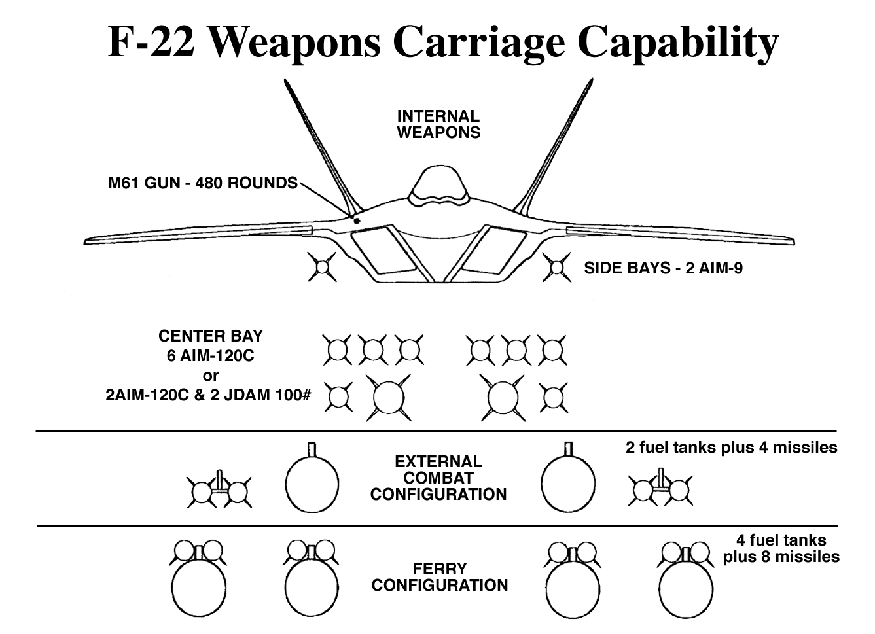
For its primary air-to-air role, the F-22 will carry six AIM-120C and two AIM-9 missiles. For its air-to-ground role, the F-22 can internally carry two 1,000 pound-class Joint Direct Attack Munitions (JDAM), two AIM-120C, and two AIM-9 missiles. With the Global Positioning System-guided JDAM, the F-22 will have an adverse weather capability to supplement the F-117 (and later the Joint Strike Fighter) for air-to-ground missions after achieving air dominance.
The F-22's combat configuration is "clean", that is, with all armament carried internally and with no external stores. This is an important factor in the F-22's stealth characteristics, and it improves the fighter's aerodynamics by dramatically reducing drag, which, in turn, improves the F-22's range. The F-22 has four under wing hardpoints, each capable of carrying 5,000 pounds. A single pylon design, which features forward and aft sway braces, an aft pivot, electrical connections, and fuel and air connections, is used. Either a 600-gallon fuel tank or two LAU-128/A missile launchers can be attached to the bottom of the pylon, depending on the mission. There are two basic external configurations for the F-22:
Four 600 gallon fuel tanks, no external weapons: This configuration is used when the aircraft is being ferried and extra range is needed. A BRU-47/A rack is used on each pylon to hold the external tanks.
Two 600 gallon fuel tanks, four missiles: This configuration is used after air dominance in a battle area has been secured, and extra loiter time and firepower is required for Combat Air Patrol (CAP). The external fuel tanks, held by a BRU-47/A rack are carried on the inboard stations, while a pylon fitted with two LAU-128/A rail launchers is fitted to each of the outboard stations. An all-missile external loadout (two missiles on each of the stations) is possible and would not be difficult technically to integrate, but the Air Force has not stated a requirement for this configuration. Prior to its selection as winner of what was then known as the Advanced Tactical Fighter (ATF) competition, the F-22 team conducted a 54-month demonstration/ validation (dem/val) program. The effort involved the design, construction and flight testing of two YF-22 prototype aircraft. Two prototype engines, the Pratt & Whitney YF119 and General Electric YF120, also were developed and tested during the program. The dem/val program was completed in December 1990. Much of that work was performed at Boeing in Seattle, Lockheed (now known as Lockheed Martin) facilities in Burbank, Calif., and at General Dynamics' Fort Worth, Texas, facilities (now known as Lockheed Martin Tactical Aircraft Systems). The prototypes were assembled in Lockheed's Palmdale, Calif., facility and made their maiden flight from there. Since that time Lockheed's program management and aircraft assembly operations have moved to Marietta, Ga., for the EMD and production phases.
The F-22 passed milestone II in 1991. At that time, the Air Force planned to acquire 648 F-22 operational aircraft at a cost of $86.6 billion. After the Bottom Up Review, completed by DOD in September 1993, the planned quantity of F-22s was reduced to 442 at an estimated cost of $71.6 billion.
A $9.55 billion contract for Engineering and Manufacturing Development (EMD) of the F-22 was awarded to the industry team of Boeing and Lockheed Martin in August 1991. Contract changes since then have elevated the contract value to approximately $11 billion. Under terms of the contract, the F-22 team will complete the design of the aircraft, produce production tooling for the program, and build and test nine flightworthy and two ground-test aircraft.
A Joint Estimate Team was chartered in June 1996 to review the F-22 program cost and schedule. JET concluded that the F-22 engineering and manufacturing development program would require additional time and funding to reduce risk before the F-22 enters production. JET estimated that the development cost would increase by about $1.45 billion. Also, JET concluded that F-22 production cost could grow by about $13 billion (from $48 billion to $61 billion) unless offset by various cost avoidance actions. As a result of the JET review the program was restructured, requiring an additional $2.2 billion be added to the EMD budget and 12 months be added to the schedule to ensure the achievement of a producible, affordable design prior to entering production. The program restructure allowed sourcing within F-22 program funds by deleting the three pre-production aircraft and slowing the production ramp. Potential for cost growth in production was contained within current budget estimate through cost reduction initiatives formalized in a government/industry memorandum of agreement. The Defense Acquisition Board principals reviewed the restructured program strategy and on February 11, 1997 the Defense Acquisition Executive issued an Acquisition Defense Memorandum approving the strategy.
The Quadrennial Defense Review Reportwhich was released in mid-May 1997, reduced the F-22 overall production quantity from 438 to 339, slowed the Low Rate Initial Production ramp from 70 to 58, and reduced the maximum production rate from 48 to 36 aircraft per year.
The F-22 EMD program marked a successful first flight on September 7, 1997. The flight test program, which has already begun in Marietta, Georgia, will continue at Edwards AFB, California through the year 2001. Low rate production is scheduled to begin in FY99. The aircraft production rate will gradually increase to 36 aircraft per year in FY 2004, and will continue that rate until all 339 aircraft have been built (projected to be complete in 2013). Initial Operational Capability of one operational squadron is slated for December 2005. The F-15 fleet is experiencing problems with avionics parts obsolescence, and the average age of the fleet will be more than 30 years when the last F-22 is delivered in 2013. But the current inventory of F-15s can be economically maintained in a structurally sound condition until 2015 or later. None of the 918 F-15s that were in the inventory in July 1992 will begin to exceed their expected economic service lives until 2014.
Specifications
Function
Air superiority fighter
Contractors
Lockheed Martin Aeronautical Systems: F-22 program management, the integrated forebody (nose section) and forward fuselage (including the cockpit and inlets), leading edges of the wings, the fins and stabilators, flaps, ailerons, landing gear and final assembly of the aircraft.
Lockheed Martin Tactical Aircraft Systems: Center fuselage, stores management, integrated navigation and electronic warfare systems (INEWS), the communications, navigation, and identification (CNI) system, and the weapon support system.
Boeing: wings, aft fuselage (including the structures necessary for engine and nozzle installation), radar system development and testing, avionics integration, the training system, and flight-test development and management.
Pratt & Whitney: F119-PW-100 engines that power the Raptor.
Major Subcontractors
(partial list): Northrop Grumman, Texas Instruments, Kidde-Graviner Ltd., Allied-Signal Aerospace, Hughes Radar Systems, Harris, Fairchild Defense, GEC Avionics, Lockheed Sanders, Kaiser Electronics, Digital Equipment Corp., Rosemount Aerospace, Curtiss-Wright Flight Systems, Dowty Decoto, EDO Corp., Lear Astronics Corp., Parker-Hannifin Corp., Simmonds Precision, Sterer Engineering, TRW, XAR, Motorola, Hamilton Standard, Sanders/GE Joint Venture, Menasco Aerospace.
Propulsion
two Pratt & Whitney F119-PW-100 engines
Thrust
35,000 lbst
Length
62.08 feet, 18.90 meters
Height
16.67 feet, 5.08 meters
Wingspan
44.5 feet, 13.56 meters
Wing Area
840 square feet
Horizontal Tailspan
29 feet, 8.84 meters
Maximum Takeoff Weight
Ceiling
Speed
Mach 1.8 (supercruise: Mach 1.5)
Crew
one
Armament
Two AIM-9 Sidewinders
six AIM-120C Advanced Medium-Range Air-to-Air Missiles (AMRAAM)
one 20mm Gatling gun
two 1,000-pound Joint Direct Attack Munitions (JDAM)
First flight:
September 7, 1997
Date Deployed
deliveries beginning in 2002operational by 2004
Unit Costs
DOD's Projected Unit
Prices Before and After Restructuring
Production
--------------------------
Low-rate Full-rate
------------ ------------
Units Unit Units Unit
Estimates cost cost
-------------------------- ---- ------ ---- ------
Before restructuring 76 $142.6 362 $102.8
Restructured without 70 $200.3 368 $128.2
initiatives
Restructured with 70 $200.8 368 $ 92.4
initiatives
------------------------------------------------------
SOURCE: GAO June 1997
VRML 3-D Model
F-22 Raptor VRML by Soji Yamakawa
F-22 Raptor
The F-22 program is developing the next-generation air superiority fighter for the Air Force to counter emerging worldwide threats. It is designed to penetrate enemy airspace and achieve a first-look, first-kill capability against multiple targets. The F-22 is characterized by a low-observable, highly maneuverable airframe; advanced integrated avionics; and aerodynamic performance allowing supersonic cruise without afterburner.
Stealth: Greatly increases survivability and lethality by denying the enemy critical information required to successfully attack the F-22
Integrated Avionics: Allows F-22 pilots unprecedented awareness of enemy forces through the fusion of on- and off-board information
Supercruise: Enhances weapons effectiveness; allows rapid transit through the battlespace; reduces the enemy’s time to counter attack
The F-22's engine is expected to be the first to provide the ability to fly faster than the speed of sound for an extended period of time without the high fuel consumption characteristic of aircraft that use afterburners to achieve supersonic speeds. It is expected to provide high performance and high fuel efficiency at slower speeds as well.
For its primary air-to-air role, the F-22 will carry six AIM-120C and two AIM-9 missiles. For its air-to-ground role, the F-22 can internally carry two 1,000 pound-class Joint Direct Attack Munitions (JDAM), two AIM-120C, and two AIM-9 missiles. With the Global Positioning System-guided JDAM, the F-22 will have an adverse weather capability to supplement the F-117 (and later the Joint Strike Fighter) for air-to-ground missions after achieving air dominance.
The F-22's combat configuration is "clean", that is, with all armament carried internally and with no external stores. This is an important factor in the F-22's stealth characteristics, and it improves the fighter's aerodynamics by dramatically reducing drag, which, in turn, improves the F-22's range. The F-22 has four under wing hardpoints, each capable of carrying 5,000 pounds. A single pylon design, which features forward and aft sway braces, an aft pivot, electrical connections, and fuel and air connections, is used. Either a 600-gallon fuel tank or two LAU-128/A missile launchers can be attached to the bottom of the pylon, depending on the mission. There are two basic external configurations for the F-22:
Four 600 gallon fuel tanks, no external weapons: This configuration is used when the aircraft is being ferried and extra range is needed. A BRU-47/A rack is used on each pylon to hold the external tanks.
Two 600 gallon fuel tanks, four missiles: This configuration is used after air dominance in a battle area has been secured, and extra loiter time and firepower is required for Combat Air Patrol (CAP). The external fuel tanks, held by a BRU-47/A rack are carried on the inboard stations, while a pylon fitted with two LAU-128/A rail launchers is fitted to each of the outboard stations. An all-missile external loadout (two missiles on each of the stations) is possible and would not be difficult technically to integrate, but the Air Force has not stated a requirement for this configuration. Prior to its selection as winner of what was then known as the Advanced Tactical Fighter (ATF) competition, the F-22 team conducted a 54-month demonstration/ validation (dem/val) program. The effort involved the design, construction and flight testing of two YF-22 prototype aircraft. Two prototype engines, the Pratt & Whitney YF119 and General Electric YF120, also were developed and tested during the program. The dem/val program was completed in December 1990. Much of that work was performed at Boeing in Seattle, Lockheed (now known as Lockheed Martin) facilities in Burbank, Calif., and at General Dynamics' Fort Worth, Texas, facilities (now known as Lockheed Martin Tactical Aircraft Systems). The prototypes were assembled in Lockheed's Palmdale, Calif., facility and made their maiden flight from there. Since that time Lockheed's program management and aircraft assembly operations have moved to Marietta, Ga., for the EMD and production phases.
The F-22 passed milestone II in 1991. At that time, the Air Force planned to acquire 648 F-22 operational aircraft at a cost of $86.6 billion. After the Bottom Up Review, completed by DOD in September 1993, the planned quantity of F-22s was reduced to 442 at an estimated cost of $71.6 billion.
A $9.55 billion contract for Engineering and Manufacturing Development (EMD) of the F-22 was awarded to the industry team of Boeing and Lockheed Martin in August 1991. Contract changes since then have elevated the contract value to approximately $11 billion. Under terms of the contract, the F-22 team will complete the design of the aircraft, produce production tooling for the program, and build and test nine flightworthy and two ground-test aircraft.
A Joint Estimate Team was chartered in June 1996 to review the F-22 program cost and schedule. JET concluded that the F-22 engineering and manufacturing development program would require additional time and funding to reduce risk before the F-22 enters production. JET estimated that the development cost would increase by about $1.45 billion. Also, JET concluded that F-22 production cost could grow by about $13 billion (from $48 billion to $61 billion) unless offset by various cost avoidance actions. As a result of the JET review the program was restructured, requiring an additional $2.2 billion be added to the EMD budget and 12 months be added to the schedule to ensure the achievement of a producible, affordable design prior to entering production. The program restructure allowed sourcing within F-22 program funds by deleting the three pre-production aircraft and slowing the production ramp. Potential for cost growth in production was contained within current budget estimate through cost reduction initiatives formalized in a government/industry memorandum of agreement. The Defense Acquisition Board principals reviewed the restructured program strategy and on February 11, 1997 the Defense Acquisition Executive issued an Acquisition Defense Memorandum approving the strategy.
The Quadrennial Defense Review Reportwhich was released in mid-May 1997, reduced the F-22 overall production quantity from 438 to 339, slowed the Low Rate Initial Production ramp from 70 to 58, and reduced the maximum production rate from 48 to 36 aircraft per year.
The F-22 EMD program marked a successful first flight on September 7, 1997. The flight test program, which has already begun in Marietta, Georgia, will continue at Edwards AFB, California through the year 2001. Low rate production is scheduled to begin in FY99. The aircraft production rate will gradually increase to 36 aircraft per year in FY 2004, and will continue that rate until all 339 aircraft have been built (projected to be complete in 2013). Initial Operational Capability of one operational squadron is slated for December 2005. The F-15 fleet is experiencing problems with avionics parts obsolescence, and the average age of the fleet will be more than 30 years when the last F-22 is delivered in 2013. But the current inventory of F-15s can be economically maintained in a structurally sound condition until 2015 or later. None of the 918 F-15s that were in the inventory in July 1992 will begin to exceed their expected economic service lives until 2014.
Specifications
Function
Air superiority fighter
Contractors
Lockheed Martin Aeronautical Systems: F-22 program management, the integrated forebody (nose section) and forward fuselage (including the cockpit and inlets), leading edges of the wings, the fins and stabilators, flaps, ailerons, landing gear and final assembly of the aircraft.
Lockheed Martin Tactical Aircraft Systems: Center fuselage, stores management, integrated navigation and electronic warfare systems (INEWS), the communications, navigation, and identification (CNI) system, and the weapon support system.
Boeing: wings, aft fuselage (including the structures necessary for engine and nozzle installation), radar system development and testing, avionics integration, the training system, and flight-test development and management.
Pratt & Whitney: F119-PW-100 engines that power the Raptor.
Major Subcontractors
(partial list): Northrop Grumman, Texas Instruments, Kidde-Graviner Ltd., Allied-Signal Aerospace, Hughes Radar Systems, Harris, Fairchild Defense, GEC Avionics, Lockheed Sanders, Kaiser Electronics, Digital Equipment Corp., Rosemount Aerospace, Curtiss-Wright Flight Systems, Dowty Decoto, EDO Corp., Lear Astronics Corp., Parker-Hannifin Corp., Simmonds Precision, Sterer Engineering, TRW, XAR, Motorola, Hamilton Standard, Sanders/GE Joint Venture, Menasco Aerospace.
Propulsion
two Pratt & Whitney F119-PW-100 engines
Thrust
35,000 lbst
Length
62.08 feet, 18.90 meters
Height
16.67 feet, 5.08 meters
Wingspan
44.5 feet, 13.56 meters
Wing Area
840 square feet
Horizontal Tailspan
29 feet, 8.84 meters
Maximum Takeoff Weight
Ceiling
Speed
Mach 1.8 (supercruise: Mach 1.5)
Crew
one
Armament
Two AIM-9 Sidewinders
six AIM-120C Advanced Medium-Range Air-to-Air Missiles (AMRAAM)
one 20mm Gatling gun
two 1,000-pound Joint Direct Attack Munitions (JDAM)
First flight:
September 7, 1997
Date Deployed
deliveries beginning in 2002operational by 2004
Unit Costs
DOD's Projected Unit
Prices Before and After Restructuring
Production
--------------------------
Low-rate Full-rate
------------ ------------
Units Unit Units Unit
Estimates cost cost
-------------------------- ---- ------ ---- ------
Before restructuring 76 $142.6 362 $102.8
Restructured without 70 $200.3 368 $128.2
initiatives
Restructured with 70 $200.8 368 $ 92.4
initiatives
------------------------------------------------------
SOURCE: GAO June 1997
VRML 3-D Model
F-22 Raptor VRML by Soji Yamakawa
Subscribe to:
Comments (Atom)